* (restored)
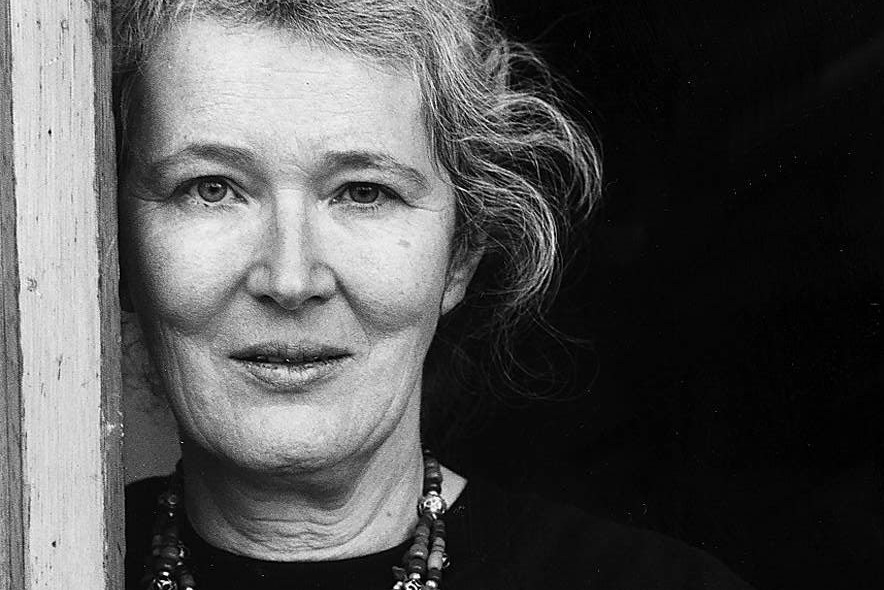
‘In The Bloody Chamber we encounter some of the best-known stories in Western literature – fairy tales by Charles Perrault, Jeanne-Marie Leprince de Beaumont and the Brothers Grimm – twisted into extraordinary new shapes. The collection, published in 1979, was Angela Carter’s ninth book of fiction, and while channels of fairy tales and myth run through her prior work, nowhere does she engage with those genres so directly and disruptively as here. The journalist and critic Lorna Sage, a close friend of Carter’s and an insightful reader of her work, describes how throughout the 1970s she became ‘more explicitly and systematically interested in narrative models that pre-date the novel: fairy tales, folktales, and other forms that develop by accretion and retelling’.
‘Carter’s approach wasn’t new. Robert Coover rewrote ‘Little Red Riding Hood’ and ‘Hansel and Gretel’ in his 1969 collection Pricksongs and Descants; two years later the poet Anne Sexton published her revisionist take on fairy tales, Transformations; and in 1976 came Bruno Bettelheim’s Freudian analysis of fairy tales, The Uses of Enchantment. Earlier in the century, meanwhile, the Danish writer Isak Dinesen (Karen Blixen) had written a sequence of complex gothic variants on northern European folk models, stories that should rightly be considered forerunners to The Bloody Chamber. But if Carter’s point of origin was far from unique, her destination would prove to be.
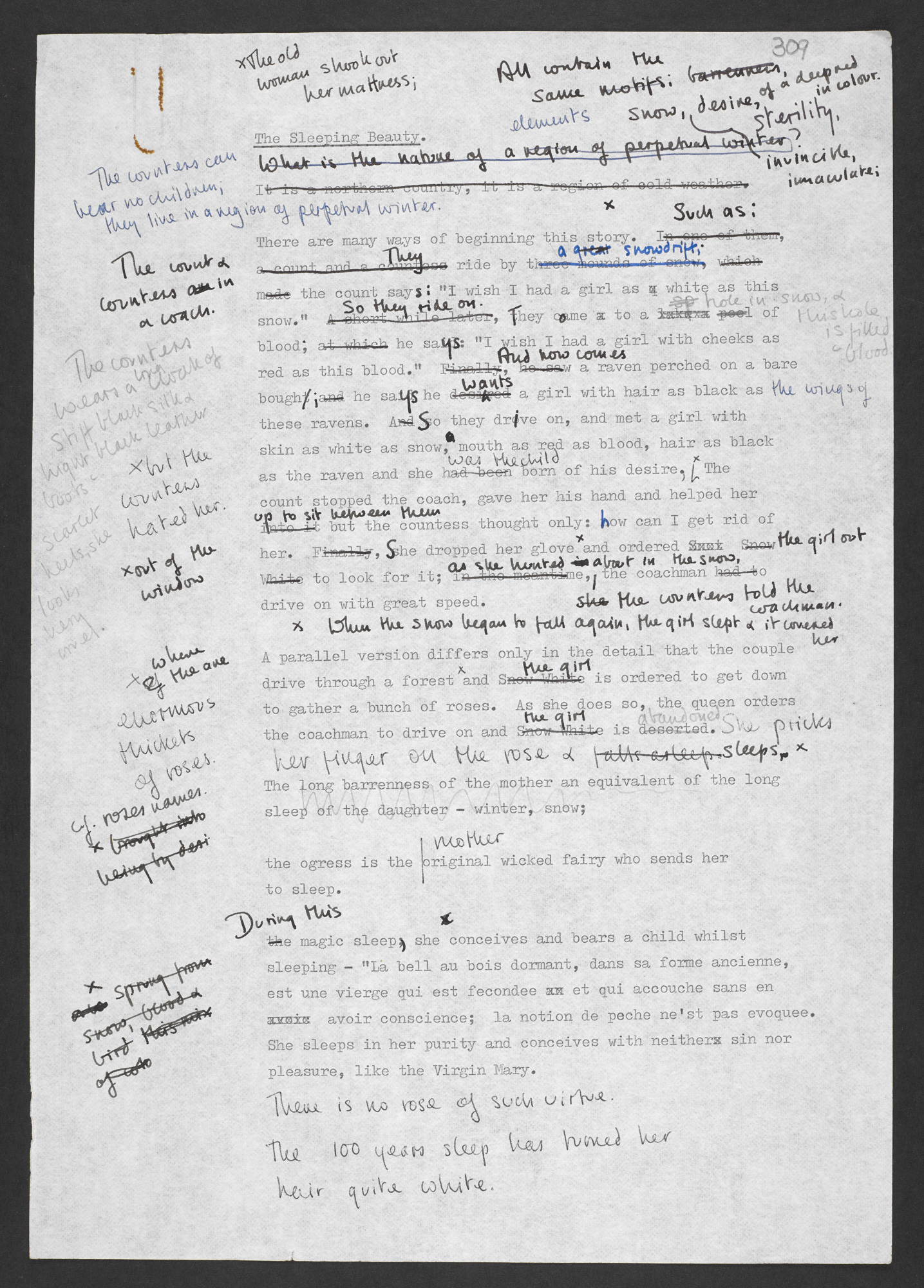
‘In 1977 she published her own translation of Charles Perrault’s fairy tales. By retelling these tales, writes Sage, Carter was ‘deliberately drawing them out of shape … The monsters and the princesses lose their places in the old script, and cross forbidden boundary lines’. Carter’s variations on three of these stories – ‘Bluebeard’, ‘Puss in Boots’ and ‘Little Red Riding Hood’ – usefully demonstrate the variations in tone that exist between what Carter called her ‘reformulations’. Her ‘Bluebeard’, entitled ‘The Bloody Chamber’, is an elaborate, disturbing tale of sexual predation and victimhood, the lush descriptiveness and mounting tension of which threatens to make the reader complicit in the exploitative, pornography-inspired lust of the sadistic Marquis. ‘Puss-in-Boots’, contrastingly, is a screwball sex comedy, while, in the stranger reaches of the book, ‘Little Red Riding Hood’ splits itself into three stories that, as in a hall of mirrors, accentuate different parts of the original (or ‘develop by accretion and retelling’, to remind ourselves of Sage’s phrase). In ‘The Werewolf’, the heroine’s granny turns out to be the wolf; in ‘The Company of Wolves’ (later filmed by Neil Jordan, with a script co-written by Carter) Red Riding Hood bats away the wolf’s threatening advances and willingly takes him to bed (‘The girl burst out laughing; she knew she was nobody’s meat’); and in ‘Wolf-Alice’ a girl raised by wolves is taken in by a lycanthropic duke. In this loose trilogy we see the different strategies Carter employs when deconstructing these old stories: sometimes tweaking the familiar into oddness, sometimes reaching back to earlier versions that pre-date Perrault or Grimm, and sometimes letting her own inventiveness seize the reins.
‘One thing common to all the stories in The Bloody Chamber, however, is the centrality of gender politics: ‘I was using the latent content of those traditional stories’, she said in a 1985 interview, ‘and that latent content is violently sexual.’ Carter published another book in 1979, an extended essay on pornography and the Marquis de Sade called The Sadeian Woman, that has been described as ‘a parallel text, or polemical preface’ to The Bloody Chamber. In it, she argues that despite Sade’s evident misogyny, he was nevertheless correct to treat ‘all sexual reality as political reality’. She is particularly interested in two of Sade’s female characters, Justine and Juliette. The former is a sexual stereotype: meek, collusive in her own victimisation at the hands of predatory males. Juliette, meanwhile, is as sexually domineering as any man. While she states that separately these types are ‘both … without hope’, nevertheless they ‘mutually reflect and complement one another, like a pair of mirrors’.
‘Perhaps one of the reasons why The Bloody Chamber was such a controversial work, and remains a contested one today, is because it doesn’t conform to a single position, for example orthodox feminism, but shape-shifts from story to story. So some critics attack Carter’s reduction of all men to predatory sadists, while others regret that her heroines, however resourceful and independent, still mostly want to bag a man. But Carter was an artist, not an ideologue; she told the stories she wanted to tell, and they are not stories that make a single point, or follow a specific ideology. She said that ‘provoking unease’ is the only moral purpose of a tale, and she was always more interested in confounding beliefs than confirming them. Like the fairy tales she transmuted, and the folktales that came before them, there are all sorts of spaces in her stories – a maze of chambers – into which interpretation can flow.’ — Chris Power
____
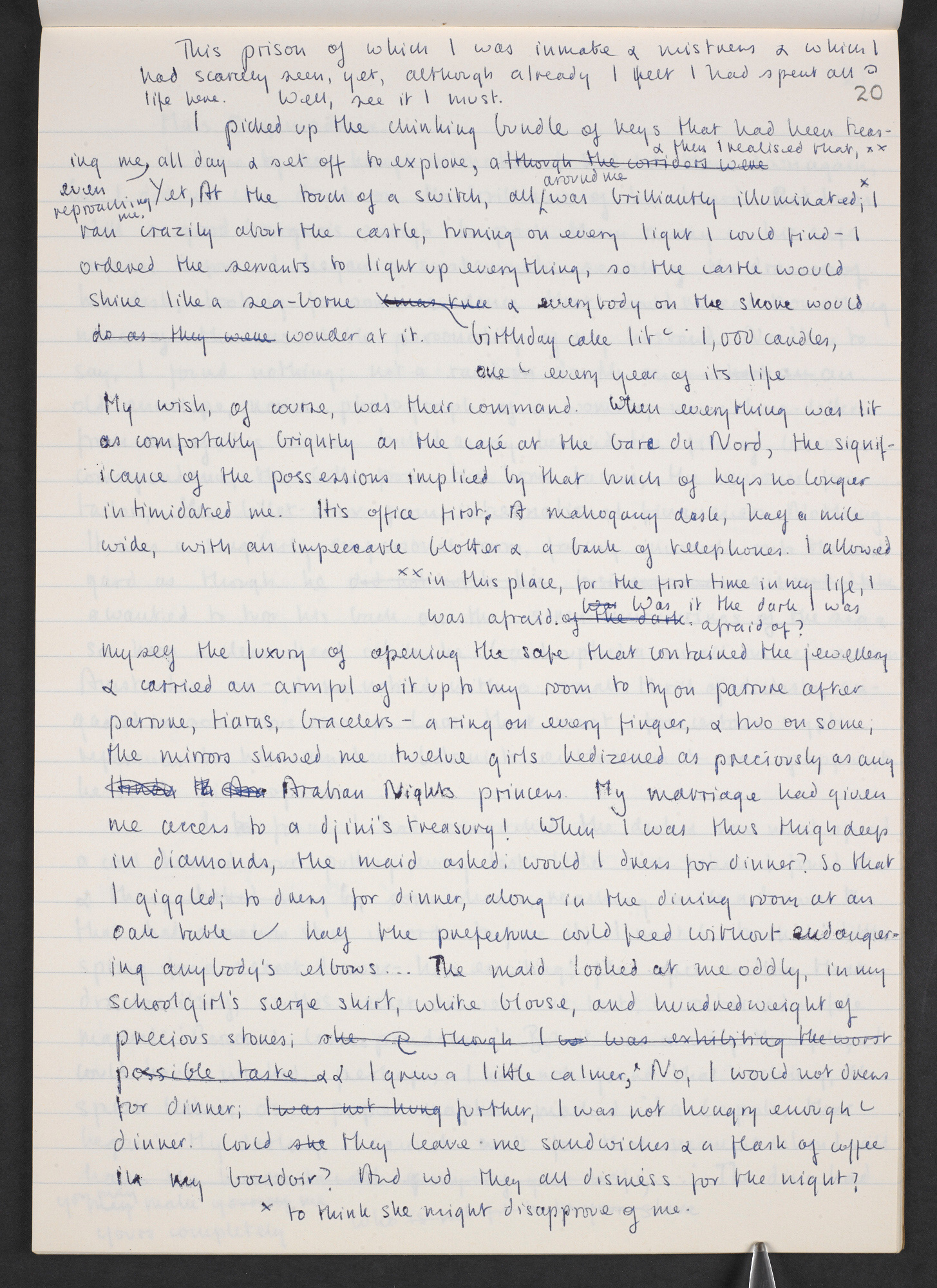
Manuscript pages
_____
Further
Angela Carter Site
ANGELA CARTER SOCIETY
Get Angela Carter
Angela Carter: Far from the fairytale
Angela Carter: Glam rock feminist
Your favorite writer Angela Carter was a socialist too!
A Conversation with Angela Carter By Anna Katsavos
The Thrill and Pain of Inventing Angela Carter
Conjuring the Curse of Repetition or “ Sleeping Beauty ” Revamped
‘Sugar Daddy’, by Angela Carter
Radical writing: Was Angela Carter ahead of her time?
ANGELA CARTER: POSTCARDS FROM AMERICA
On Angela Carter by Sharlene Teo
Rereading Angela Carter
Finding Angela Carter: An Interview with Biographer Edmund Gordon
Breaking the Spell
Marina Warner on why Angela Carter’s The Bloody Chamber still bites
Angela Carter: a seminal novelist who changed writing and the world
The Lives, and Fictions, of Angela Carter
Angela Carter’s taste for the fantastic
Fairytales Punish the Curious
Belle Dame Sans Merci: On Angela Carter
____
Extras
Angela Carter talks to Lisa Appignanesi
‘If God is a snail’: Angela Carter on food
Angela Carter and Neil Jordan discuss ‘A Company of Wolves’
____
Interview
from BOMB
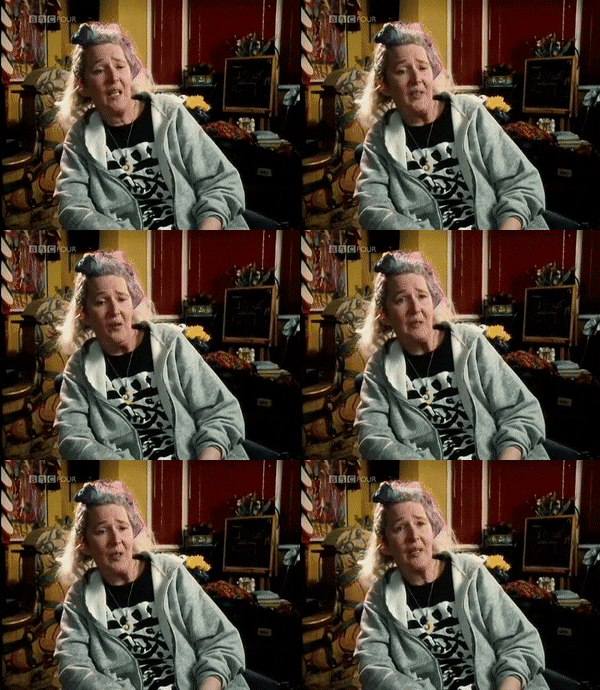
Rosemary Carroll I have been wanting to ask you whether you liked Neil Jordan’s film version of your story The Company of Wolves?
Angela Carter Well, I wrote the script, you know.
RC You and he collaborated on the script, didn’t you? I imagine the collaborative process would be very difficult. It reminds me of something William Burroughs once said to the effect that to collaborate is to lie.
AC Oh no, we got along very well. We are good friends and I enjoyed doing it. I’m just sorry for Neil’s sake that the movie didn’t do better commercially. I was afraid that would really hurt his chance to make future films. But his new movie, Mona Lisa, is doing very well, so he’s hitting the high spots.
RC But the end of the film Company of Wolves is so different from the story.
AC I was furious about the ending. It wasn’t scripted that way at all. I was out of the country — in Australia when he shot the ending and he told me that it varied somewhat from the script. When I went to the screening I sat with Neil and I was enjoying the film very much and thinking that it had turned out so well — just as I had hoped. Until the ending which I couldn’t believe — I was so upset, I said, “You’ve ruined it.” He was apologetic.
RC How had the ending originally been scripted?
AC After she encounters the wolf at her grandmother’s house and what has happened becomes apparent she wakes up. Her body elongates beautifully and she does a perfect swan dive into the floorboards which turn into the surface of a body of water that swallows her. But that proved impossible to film. They tried covering the floor with water, but that didn’t work and she couldn’t just dive into the floor.
But even if it wasn’t possible to end the film as planned, I wish he had ended it right after the part where the white rose turns red.
RC I prefer the way your story ends—with her lying in grandmother’s bed between the wolf’s paws.
AC I do, too. Neil kept trying to convince me that his ending was potentially more ambiguous than it seemed. He maintains that her screams when the camera is panning the outside of the house are screams of pleasure, but it certainly doesn’t seem that way to me.
RC I think men frequently have the mistaken belief that women are screaming in pleasure rather than in terror.
AC True. Perhaps the problem is that Sarah Peterson is not a very explicit screamer. In any case, I really did like the movie as a whole. I try to think that the falsity of the ending won’t even be noticed—everybody in the audience will be looking for their shoes and it will go right by.
RC I read an interview with Neil Jordan recently in which he asked what prompted his transition from writing fiction to making films. He said it was related to an increasing awareness on his part of the extent to which his prose had always been affected by cinema. He became more and more obsessed with the look and shape of things and began to feel that prose was an inadequate method of conveying these concerns. Is that a feeling you share? Do you have any desire to do more writing for film?
AC I enjoyed working on Company of Wolves with Neil. And I have done some other work on scripts. When I do it I like it but I have no great desire to seek it out. Right now, Granada Television is making a film based on another work of mine, my second novel, The Magic Toyshop. I’m quite pleased with it actually. It will be a television movie, at least initially, and so, of course, the budget is much lower than it was for Company of Wolves. The cast includes this wonderful English actor, Tom Bell, have you ever heard of him?
RC No, is he going to play Finn?
AC No. He is cast as the uncle. He specializes in heavies—gangsters, Nazis and so on. He has a fantastic knack for portraying motiveless malignity, he will be just right. The director, David Wheatley, has worked mostly for British television — what drew us together was a film he made ages ago about the Brothers Grimm, that was full of terrific imagery and invention. David started out as a sculptor, oddly enough. We had a lovely time inventing imagery for The Magic Toyshop. He has a real feel for the book.
RC I love that book—it is such a stunning evocation of adolescence. The scene in which Melanie is trapped while climbing the tree in her mother’s wedding gown is perfect—it completely captures that feeling of uncertain anticipation. This is an underconnectedness of events and you don’t know which one is dependent on the other but you know that there is an incredibly important relation between them and it is all very wonderful and frightening at the same time.
AC You liked that? I’m glad. I am hopeful about the movie. I don’t think it will suffer from the small budget, because that story shouldn’t really require so much money to realize on film.
RC I think that is true. Besides, a lower budget doesn’t always translate into a good movie; in fact, the inverse is sometimes true. Do you feel that your prose is affected by cinema?
AC Since I’ve become a mother, I don’t go to the movies much. But certainly the way I view the world has been influenced by them. I think that must be true for most writers. The early Godard films had a very strong effect on the way I observe and see the world. They are extraordinary. And not just Godard. For example, I think of Barbara Stanwyck’s descent down the stairs in Double Indemnity. First, you see the stiletto-heeled shoe then the ankle with the chain around it, then the legs and the full, rich shine of her stockings. You know she is going to be a femme fatale long before you even see her face.
RC Have you seen Hail Mary?
AC No, I refuse to. I could hardly believe Godard would do such a thing. I’ve read about it and I saw clips from it on television and all I could think of was “Jean Luc, you have crapped upon an entire generation.”
RC What is your favorite movie?
AC You mean my favorite movie ever, of all time.
RC Yes.
AC I would have to say that it is Marcel Carne’s Les Enfants du Paradis, with a script by Jacques Prévert and extraordinary performances by just about everyone who was anybody in the French cinema: Jean-Louis Barrault, Arletty, Maria Cesarés… It is the definitive film about romanticism; and about the impossibility of happy endings; and also about the nature of monochromept by Jacques Prévert and extraordinary performances by just about everyone who was anybody in the French cinema: Jean-Louis Barrault, Arletty, Maria Cesarés… It is the definitive film about romanticism; and about the impossibility of happy endings; and also about the nature of monochrome photography, and the character of Pierrot in the Comedia del Arte and lots of things. It is an enormous, cumbersome, comprehensive world of a movie, and one in which it always seems possible to me, I might be able to jump through the screen into, and live there, in a state of luminous anguish, just like everybody else in the movie.
RC Much of your work seems to exist in the borderline area between consciousness and dreams. The stories are dreamlike in structure and share other qualities with dreams—symbolic transformations, ritualistic, referent use of name and language, and the fulfillment of unexpressed, or even denied, desire. Do you keep a journal of your dreams?
AC I don’t dream. Rather, I never remember my dreams and on the rare occasions when I do, they are completely banal. Last night, for example, I dreamed that I woke up and went to the bathroom.
But this resemblance to dreams is deliberate, conscious as it were. I have studied dreams extensively and I know about their structure and symbolism. I think dreams are a way of the mind telling itself stories. I use free association and dream imagery when I write. I like to think I have a hot line to my subconscious.
RC One of the themes that recurs is concerned with a sort of cataclysmic upheaval in childhood. Were you uprooted when you were a child?
AC All English children in my generation were, at least all those living in London. I was born in 1940. My mother left London carrying me in her arms with my 12-year-old brother. Almost no one remained actually living in London at that time. We went south to Sussex and stayed there for a while. Then we went to live with my grandmother in the country in the North. My mother would stay with my grandmother and I for a few weeks and then commute to London to be with my father and then return to us. But I remember this as a happy time somehow.
RC That is interesting to me—that you grew up essentially as an only child in a house full of women. The aspect of your work that I most appreciate is this unique sense of real love for, and protectiveness towards, other women. It is something that I look for in women writers and almost never find.
AC What you say about the feeling toward women makes me happy—because it is very important to me. But I don’t understand your comparison to other women writers. What do you mean?
RC Women writers frequently adopt a tone or an attitude toward their female characters which is somewhat negative and ungenerous. It comes across as either whining self-indulgence or congratulatory, stolid self-reliance. There is so little compassion.
AC To whom do you refer?
RC Let’s say, Joan Didion, for example.
AC Yah, boo, sucks. Although I am a card-carrying and committed feminist, what I would like to see happen to Joan Didion’s female characters is that a particularly hairy and repulsive chapter of Hells Angels descend upon their therapy group with a squeal of brakes and sweep these anorexic nutters behind them despite their squeaks of protest. Like a version, dare I say it, of the rape of the Sabine women. And bear them off to hard labour in the grease pits. Or else ten years compulsory re-education in the coffee plantations of Nicaragua might do the trick, make those girls feel there are worse things in life than running out of valium. Except what lousy fun it would be for the Angels. And the Nicaraguans might feel with justice it was a particularly foul CIA plot.
Actually, I think Joan Didion is an alien from another planet. Can we talk about a real novelist?
RC To take a somewhat less obviously despicable example, then—Doris Lessing.
AC She is quite an odd one, too. But as far as her feelings toward women or women characters go, they don’t seem objectionable.
RC She seems incapable of finding sustenance or delight in the company of women. There is such an absence of joy.
AC I wouldn’t limit it to her women characters, though. Some people think life is worth living and others really don’t see the point of the whole thing. She is one of the latter—it is her entire view of the world,
RC The only woman I can think of, off hand, who is different in this respect is Jane Bowles.
AC Now you’re talking. She is wonderful, extraordinary. But what a tragically sad end she met—it is, I suppose, a particularly poignant example of the terrifying fatality of being a woman.
___
Book
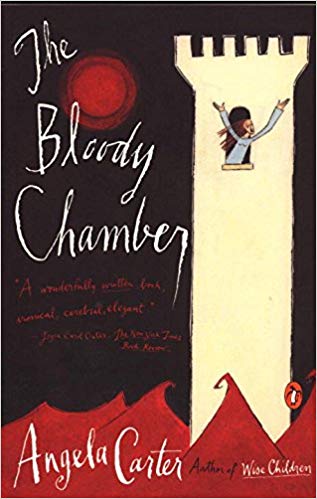 Angela Carter The Bloody Chamber: And Other Stories
Penguin Books
‘She writes a prose that lends itself to magnificent set pieces of fastidious sensuality … dreams, myths, fairy tales, metamorphoses, the unruly unconscious, epic journeys, and a highly sensual celebration of sexuality in both its most joyous and darkest manifestations.’ — Ian McEwan
‘Carter not only switches her narrative into the wholly explicit but turns the passive predicament of the heroine into one in which the convention of female role-playing seems to have no part, only brisk and derisisve common sense, the best feminine tactic in a tight corner. The tales are retold by Angla Carter with all her supple and intoxicating bravura.’ — The New York Review of Books
‘She was, among other things, a quirky, original, and baroque styleist, a trait especially marked in The Bloody Chamber – her vocabulary a mix of finely tuned phrase, luscious adjective, witty aphorism, and hearty, up-theirs vulgarity.’ — Margaret Atwood
_____
Excerpt
The Company of Wolves
One beast and only one howls in the woods by night.
The wolf is carnivore incarnate and he’s as cunning as he is ferocious; once he’s had a taste of flesh then nothing else will do.
At night, the eyes of wolves shine like candle flames, yellowish, reddish, but that is because the pupils of their eyes fatten on darkness and catch the light from your lantern to flash it back to you–red for danger; if a wolf’s eyes reflect only moonlight, then they gleam a cold and unnatural green, a mineral, a piercing colour. If the benighted traveller spies those luminous, terrible sequins stitched suddenly on the black thickets, then he knows he must run, if fear has not struck him stock-still.
But those eyes are all you will be able to glimpse of the forest assassins as they cluster invisibly round your smell of meat as you go through the wood unwisely late. They will be like shadows, they will be like wraiths, grey members of a congregation of nightmare; hark! his long, wavering howl … an aria of fear made audible.
The wolfsong is the sound of the rending you will suffer, in itself a murdering.
It is winter and cold weather. In this region of mountain and forest, there is now nothing for the wolves to eat. Goats and sheep are locked up in the byre, the deer departed for the remaining pasturage on the southern slopes–wolves grow lean and famished. There is so little flesh on them that you could count the starveling ribs through their pelts, if they gave you time before they pounced. Those slavering jaws; the lolling tongue; the rime of saliva on the grizzled chops–of all the teeming perils of the night and the forest, ghosts, hobgoblins, ogres that grill babies upon gridirons, witches that fatten their captives in cages for cannibal tables, the wolf is worst for he cannot listen to reason.
You are always in danger in the forest, where no people are. Step between the portals of the great pines where the shaggy branches tangle about you, trapping the unwary traveller in nets as if the vegetation itself were in a plot with the wolves who live there, as though the wicked trees go fishing on behalf of their friends–step between the gateposts of the forest with the greatest trepidation and infinite precautions, for if you stray from the path for one instant, the wolves will eat you. They are grey as famine, they are as unkind as plague.
The grave-eyed children of the sparse villages always carry knives with them when they go out to tend the little flocks of goats that provide the homesteads with acrid milk and rank, maggoty cheeses. Their knives are half as big as they are, the blades are sharpened daily.
But the wolves have ways of arriving at your own hearthside. We try and try but sometimes we cannot keep them out. There is no winter’s night the cottager does not fear to see a lean, grey, famished snout questing under the door, and there was a woman once bitten in her own kitchen as she was straining the macaroni.
Fear and flee the wolf; for, worst of all, the wolf may be more than he seems.
There was a hunter once, near here, that trapped a wolf in a pit. This wolf had massacred the sheep and goats; eaten up a mad old man who used to live by himself in a hut halfway up the mountain and sing to Jesus all day; pounced on a girl looking after the sheep, but she made such a commotion that men came with rifles and scared him away and tried to track him into the forest but he was cunning and easily gave them the slip. So this hunter dug a pit and put a duck in it, for bait, all alive-oh; and he covered the pit with straw smeared with wolf dung. Quack, quack! went the duck and a wolf came slinking out of the forest, a big one, a heavy one, he weighed as much as a grown man and the straw gave way beneath him–into the pit he tumbled. The hunter jumped down after him, slit his throat, cut off all his paws for a trophy.
And then no wolf at all lay in front of the hunter but the bloody trunk of a man, headless, footless, dying, dead.
A witch from up the valley once turned an entire wedding party into wolves because the groom had settled on another girl. She used to order them to visit her, at night, from spite, and they would sit and howl around her cottage for her, serenading her with their misery.
Not so very long ago, a young woman in our village married a man who vanished clean away on her wedding night. The bed was made with new sheets and the bride lay down in it; the groom said, he was going out to relieve himself, insisted on it, for the sake of decency, and she drew the coverlet up to her chin and she lay there. And she waited and she waited and then she waited again–surely he’s been gone a long time? Until she jumps up in bed and shrieks to hear a howling, coming on the wind from the forest.
That long-drawn, wavering howl has, for all its fearful resonance, some inherent sadness in it, as if the beasts would love to be less beastly if only they knew how and never cease to mourn their own condition. There is a vast melancholy in the canticles of the wolves, melancholy infinite as the forest, endless as these long nights of winter and yet that ghastly sadness, that mourning for their own, irremediable appetites, can never move the heart for not one phrase in it hints at the possibility of redemption; grace could not come to the wolf from its own despair, only through some external mediator, so that, sometimes, the beast will look as if he half welcomes the knife that dispatches him.
The young woman’s brothers searched the outhouses and the haystacks but never found any remains so the sensible girl dried her eyes and found herself another husband not too shy to piss into a pot who spent the nights indoors. She gave him a pair of bonny babies and all went right as a trivet until, one freezing night, the night of the solstice, the hinge of the year when things do not fit together as well as they should, the longest night, her first good man came home again.
A great thump on the door announced him as she was stirring the soup for the father of her children and she knew him the moment she lifted the latch to him although it was years since she’d worn black for him and now he was in rags and his hair hung down his back and never saw a comb, alive with lice.
‘Here I am again, missus,’ he said.’ Get me my bowl of cabbage and be quick about it.’
Then her second husband came in with wood for the fire and when the first one saw she’d slept with another man and, worse, clapped his red eyes on her little children who’d crept into the kitchen to see what all the din was about, he shouted: ‘I wish I were a wolf again, to teach this whore a lesson!’ So a wolf he instantly became and tore off the eldest boy’s left foot before he was chopped up with the hatchet they used for chopping logs. But when the wolf lay bleeding and gasping its last, the pelt peeled off again and he was just as he had been, years ago, when he ran away from his marriage bed, so that she wept and her second husband beat her.
They say there’s an ointment the Devil gives you that turns you into a wolf the minute you rub it on. Or, that he was born feet first and had a wolf for his father and his torso is a man’s but his legs and genitals are a wolf’s. And he has a wolf’s heart.
Seven years is a werewolf’s natural span but if you burn his human clothing you condemn him to wolfishness for the rest of his life, so old wives hereabouts think it some protection to throw a hat or an apron at the werewolf, as if clothes made the man. Yet by the eyes, those phosphorescent eyes, you know him in all his shapes; the eyes alone unchanged by metamorphosis.
Before he can become a wolf, the lycanthrope strips stark naked. If you spy a naked man among the pines, you must run as if the Devil were after you.
It is midwinter and the robin, the friend of man, sits on the handle of the gardener’s spade and sings. It is the worst time in all the year for wolves but this strong-minded child insists she will go off through the wood. She is quite sure the wild beasts cannot harm her although, well-warned, she lays a carving knife in the basket her mother has packed with cheeses. There is a bottle of harsh liquor distilled from brambles; a batch of flat oatcakes baked on the hearthstone; a pot or two of jam. The flaxen-haired girl will take these delicious gifts to a reclusive grandmother so old the burden of her years is crushing her to death. Granny lives two hours’ trudge through the winter woods; the child wraps herself up in her thick shawl, draws it over her head. She steps into her stout wooden shoes; she is dressed and ready and it is Christmas Eve. The malign door of the solstice still swings upon its hinges but she has been too much loved ever to feel scared.
Children do not stay young for long in this savage country. There are no toys for them to play with so they work hard and grow wise but this one, so pretty and the youngest of her family, a little late-comer, had been indulged by her mother and the grandmother who’d knitted her the red shawl that, today, has the ominous if brilliant look of blood on snow. Her breasts have just begun to swell; her hair is like lint, so fair it hardly makes a shadow on her pale forehead; her cheeks are an emblematic scarlet and white and she has just started her woman’s bleeding, the clock inside her that will strike, henceforward, once a month.
She stands and moves within the invisible pentacle of her own virginity. She is an unbroken egg; she is a sealed vessel; she has inside her a magic space the entrance to which is shut tight with a plug of membrane; she is a closed system; she does not know how to shiver. She has her knife and she is afraid of nothing.
Her father might forbid her, if he were home, but he is away in the forest, gathering wood, and her mother cannot deny her.
The forest closed upon her like a pair of jaws.
There is always something to look at in the forest, even in the middle of winter–the huddled mounds of birds, succumbed to the lethargy of the season, heaped on the creaking boughs and too forlorn to sing; the bright frills of the winter fungi on the blotched trunks of the trees; the cuneiform slots of rabbits and deer, the herringbone tracks of the birds, a hare as lean as a rasher of bacon streaking across the path where the thin sunlight dapples the russet brakes of last year’s bracken.
When she heard the freezing howl of a distant wolf, her practised hand sprang to the handle of her knife, but she saw no sign of a wolf at all, nor of a naked man, neither, but then she heard a clattering among the brushwood and there sprang on to the path a fully clothed one, a very handsome young one, in the green coat and wideawake hat of a hunter, laden with carcasses of game birds. She had her hand on her knife at the first rustle of twigs but he laughed with a flash of white teeth when he saw her and made her a comic yet flattering little bow; she’d never seen such a fine fellow before, not among the rustic clowns of her native village. So on they went together, through the thickening light of the afternoon.
Soon they were laughing and joking like old friends. When he offered to carry her basket, she gave it to him although her knife was in it because he told her his rifle would protect them. As the day darkened, it began to snow again; she felt the first flakes settle on her eyelashes but now there was only half a mile to go and there would be a fire, and hot tea, and a welcome, a warm one, surely, for the dashing huntsman as well as for herself.
This young man had a remarkable object in his pocket. It was a compass. She looked at the little round glass face in the palm of his hand and watched the wavering needle with a vague wonder. He assured her this compass had taken him safely through the wood on his hunting trip because the needle always told him with perfect accuracy where the north was. She did not believe it; she knew she should never leave the path on the way through the wood or else she would be lost instantly. He laughed at her again; gleaming trails of spittle clung to his teeth. He said, if he plunged off the path into the forest that surrounded them, he could guarantee to arrive at her grandmother’s house a good quarter of an hour before she did, plotting his way through the undergrowth with his compass, while she trudged the long way, along the winding path.
I don’t believe you. Besides, aren’t you afraid of the wolves?
He only tapped the gleaming butt of his rifle and grinned.
Is it a bet? he asked her. Shall we make a game of it? What will you give me if I get to your grandmother’s house before you?
What would you like? she asked disingenuously.
A kiss.
Commonplaces of a rustic seduction; she lowered her eyes and blushed.
He went through the undergrowth and took her basket with him but she forgot to be afraid of the beasts, although now the moon was rising, for she wanted to dawdle on her way to make sure the handsome gentleman would win his wager.
Grandmother’s house stood by itself a little way out of the village. The freshly falling snow blew in eddies about the kitchen garden and the young man stepped delicately up the snowy path to the door as if he were reluctant to get his feet wet, swinging his bundle of game and the girl’s basket and humming a little tune to himself.
There is a faint trace of blood on his chin; he has been snacking on his catch.
He rapped upon the panels with his knuckles.
Aged and frail, granny is three-quarters succumbed to the mortality the ache in her bones promises her and almost ready to give in entirely. A boy came out from the village to build up her hearth for the night an hour ago and the kitchen crackles with busy firelight. She has her Bible for company, she is a pious old woman. She is propped up on several pillows in the bed set into the wall peasant-fashion, wrapped up in the patchwork quilt she made before she was married, more years ago than she cares to remember. Two china spaniels with liver-coloured blotches on their coats and black noses sit on either side of the fireplace. There is a bright rug of woven rags on the pantiles. The grandfather clock ticks away her eroding time.
We keep the wolves outside by living well.
He rapped upon the panels with his hairy knuckles.
It is your granddaughter, he mimicked in a high soprano:
Lift up the latch and walk in, my darling.
You can tell them by their eyes, eyes of a beast of prey, nocturnal, devastating eyes as red as a wound; you can hurl your Bible at him and your apron after, granny, you thought that was a sure prophylactic against these infernal vermin … now call on Christ and his mother and all the angels in heaven to protect you but it won’t do you any good.
His feral muzzle is sharp as a knife; he drops his golden burden of gnawed pheasant on the table and puts down your dear girl’s basket, too. Oh, my God, what have you done with her?
Off with his disguise, that coat of forest-coloured cloth, the hat with the feather tucked into the ribbon; his matted hair streams down his white shirt and she can see the lice moving in it. The sticks in the hearth shift and hiss; night and the forest has come into the kitchen with darkness tangled in its hair.
He strips off his shirt. His skin is the colour and texture of vellum. A crisp stripe of hair runs down his belly, his nipples are ripe and dark as poison fruit but he’s so thin you could count the ribs under his skin if only he gave you the time. He strips off his trousers and she can see how hairy his legs are. His genitals, huge. Ah! huge.
The last thing the old lady saw in all this world was a young man, eyes like cinders, naked as a stone, approaching her bed.
The wolf is carnivore incarnate.
When he had finished with her, he licked his chops and quickly dressed himself again, until he was just as he had been when he came through her door. He burned the inedible hair in the fireplace and wrapped the bones up in a napkin that he hid away under the bed in the wooden chest in which he found a clean pair of sheets. These he carefully put on the bed instead of the tell-tale stained ones he stowed away in the laundry basket. He plumped up the pillows and shook out the patchwork quilt, he picked up the Bible from the floor, closed it and laid it on the table. All was as it had been before except that grandmother was gone. The sticks twitched in the grate, the clock ticked and the young man sat patiently, deceitfully beside the bed in granny’s nightcap.
Rat-a-tap-tap.
Who’s there, he quavers in granny’s antique falsetto.
Only your granddaughter.
So she came in, bringing with her a flurry of snow that melted in tears on the tiles, and perhaps she was a little disappointed to see only her grandmother sitting beside the fire. But then he flung off the blanket and sprang to the door, pressing his back against it so that she could not get out again.
The girl looked round the room and saw there was not even the indentation of a head on the smooth cheek of the pillow and how, for the first time she’d seen it so, the Bible lay closed on the table. The tick of the clock cracked like a whip. She wanted her knife from her basket but she did not dare reach for it because his eyes were fixed upon her–huge eyes that now seemed to shine with a unique, interior light, eyes the size of saucers, saucers full of Greek fire, diabolic phosphorescence.
What big eyes you have.
All the better to see you with.
No trace at all of the old woman except for a tuft of white hair that had caught in the bark of an unburned log. When the girl saw that, she knew she was in danger of death.
Where is my grandmother?
There’s nobody here but we two, my darling.
Now a great howling rose up all around them, near, very near, as close as the kitchen garden, the howling of a multitude of wolves; she knew the worst wolves are hairy on the inside and she shivered, in spite of the scarlet shawl she pulled more closely round herself as if it could protect her although it was as red as the blood she must spill.
Who has come to sing us carols, she said.
Those are the voices of my brothers, darling; I love the company of wolves. Look out of the window and you’ll see them.
Snow half-caked the lattice and she opened it to look into the garden. It was a white night of moon and snow; the blizzard whirled round the gaunt, grey beasts who squatted on their haunches among the rows of winter cabbage, pointing their sharp snouts to the moon and howling as if their hearts would break. Ten wolves; twenty wolves–so many wolves she could not count them, howling in concert as if demented or deranged. Their eyes reflected the light from the kitchen and shone like a hundred candles.
It is very cold, poor things, she said; no wonder they howl so.
She closed the window on the wolves’ threnody and took off her scarlet shawl, the colour of poppies, the colour of sacrifices, the colour of her menses, and, since her fear did her no good, she ceased to be afraid.
What shall I do with my shawl?
Throw it on the fire, dear one. You won’t need it again.
She bundled up her shawl and threw it on the blaze, which instantly consumed it. Then she drew her blouse over her head; her small breasts gleamed as if the snow had invaded the room.
What shall I do with my blouse?
Into the fire with it, too, my pet.
The thin muslin went flaring up the chimney like a magic bird and now off came her skirt, her woollen stockings, her shoes, and on to the fire they went, too, and were gone for good. The firelight shone through the edges of her skin; now she was clothed only in her untouched integument of flesh. This dazzling, naked she combed out her hair with her fingers; her hair looked white as the snow outside. Then went directly to the man with red eyes in whose unkempt mane the lice moved; she stood up on tiptoe and unbuttoned the collar of his shirt.
What big arms you have.
All the better to hug you with.
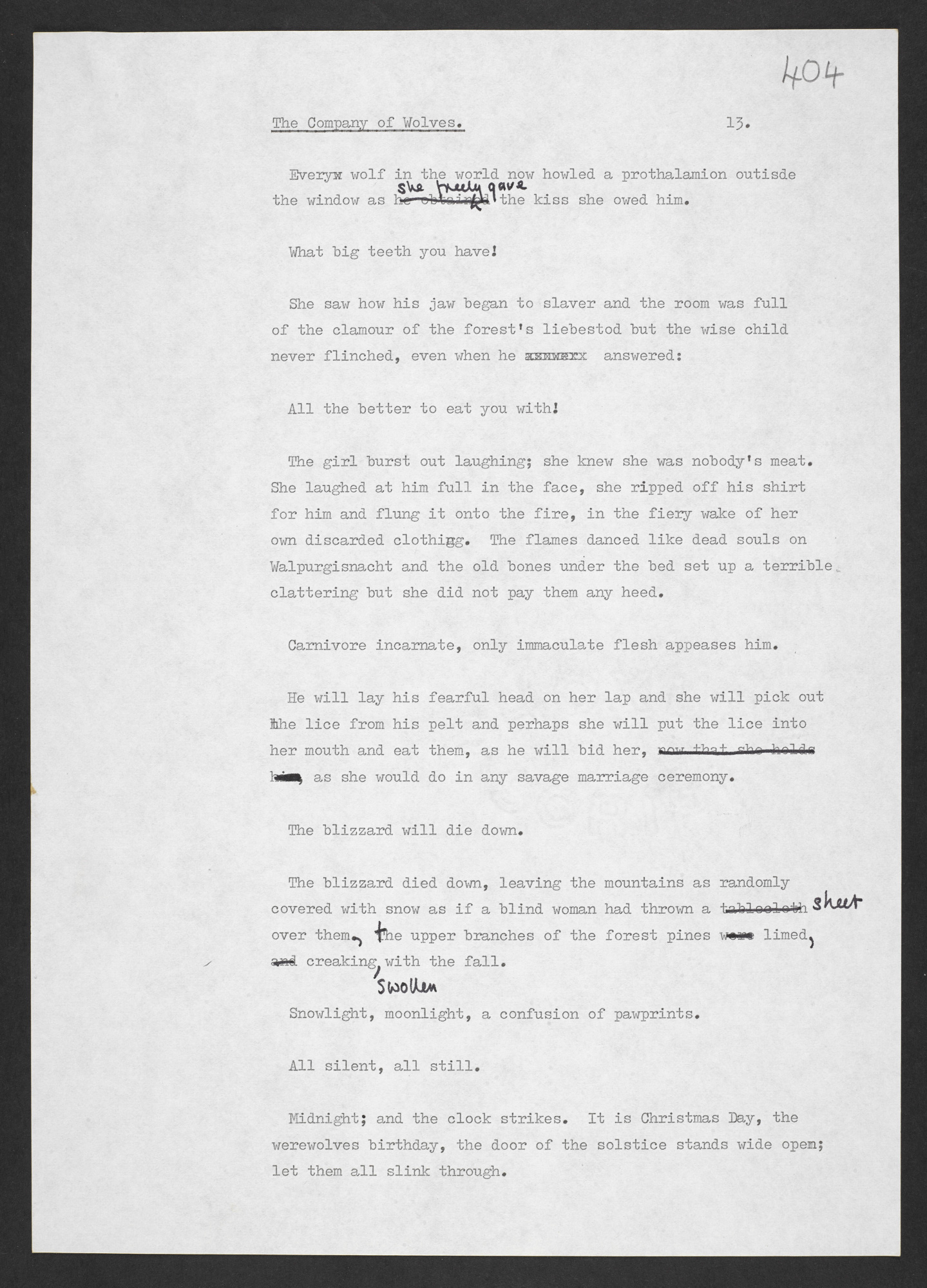
Every wolf in the world now howled a prothalamion outside the window as she freely gave the kiss she owed him.
What big teeth you have!
She saw how his jaw began to slaver and the room was full of the clamour of the forest’s Liebestod but the wise child never flinched, even when he answered:
All the better to eat you with.
The girl burst out laughing; she knew she was nobody’s meat. She laughed at him full in the face, she ripped off his shirt for him and flung it into the fire, in the fiery wake of her own discarded clothing. The flames danced like dead souls on Walpurgisnacht and the old bones under the bed set up a terrible clattering but she did not pay them any heed.
Carnivore incarnate, only immaculate flesh appeases him.
She will lay his fearful head on her lap and she will pick out the lice from his pelt and perhaps she will put the lice into her mouth and eat them, as he will bid her, as she would do in a savage marriage ceremony.
The blizzard will die down.
The blizzard died down, leaving the mountains as randomly covered with snow as if a blind woman had thrown a sheet over them, the upper branches of the forest pines limed, creaking, swollen with the fall.
Snowlight, moonlight, a confusion of paw-prints.
All silent, all still.
Midnight; and the clock strikes. It is Christmas Day, the werewolves’ birthday, the door of the solstice stands wide open; let them all sink through.
See! sweet and sound she sleeps in granny’s bed, between the paws of the tender wolf.
*
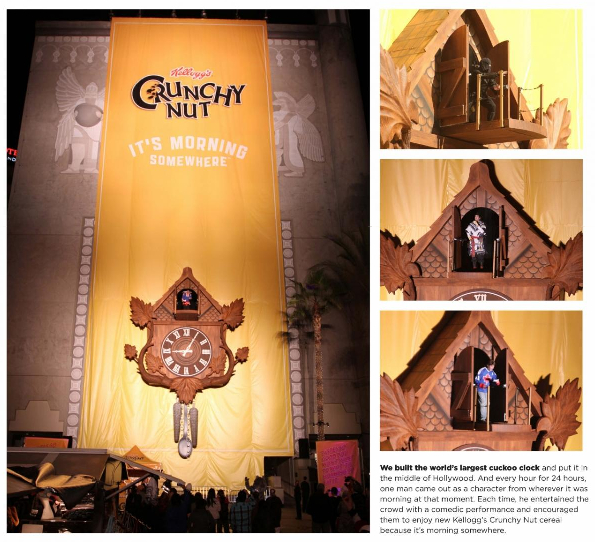
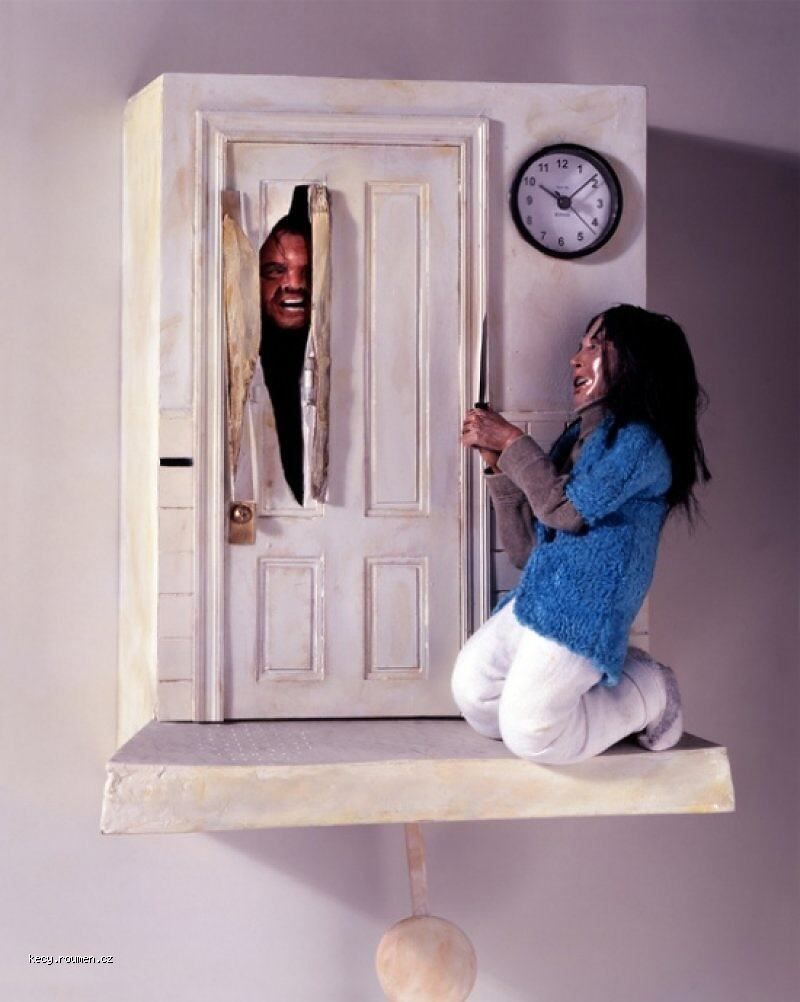
p.s. Hey. ** Dominik, Hi!!! I’m kind of the opposite. I have to force myself to chill out, and I usually can’t. Is it a crap shoot with the work jobs? I mean can you put out feelers to fiction publishers? Although I’m guessing those projects probably pay a lot less? My weekend was largely the usual film-related querying and volleying, but it was okay. I’m glad you liked that slave sentence. Its phrasing was a fave. Love forming a crappy Bauhaus cover band called Bowhouse, G. ** jay, Hi. I have a feeling that Kris was totally psyched by your comment. Great week! ** kenley, Hey. I’d already seen the show at the Palais, so I wasn’t tempted to fork out the 15 euros. It’s a group show that attempts to be about the influence of French theory on American visual art, but it wasn’t so successful. A handful of cool things. Wow, you’re a soup master, to me at least for sure. I fear a bunch of those soups aren’t vegetarian but maybe adaptable? London: we don’t really know the turf there so well and so far we haven’t found a theater or venue that’s interested. But we persist. A screening there sort of needs to happen. There’s a kind of pomegranate component to the pancake mix, like an added powder or something, and the pomegranate seeds are in the cakes. I just put butter on them. I guess you could use pomegranate syrup, but it seems that might too much of an overload? You smoke menthols! Wow, that’s intense. My favorite cigarette used to be Camel Wide Lights which you can’t get in France, but then I got used to the regular sized Camel Lights and inhaling the Wides made me slightly nauseous. That was sad. ** Laura, I’ll need to really psych myself up (or down) to try a TV show, but I will look for the mood when such a venture seems appealing. I don’t know who made that decision. The only kind of sad thing about ‘Closer’ getting a new and arguably better cover is that the old cover had a secret message if you looked at it a certain way: ‘O no’. I trust that you remain relatively stationary. ** Dev, Hey, Dev! Wow, all the luck in the world that you need getting through the intensive two weeks and of course beyond. I’m sure you’ll ace everything. The blog will be here for you to view and enter at your leisure, should you have any. I want to go to New Orleans, and a coffee with you is one of the biggest reasons. Great about your daughter and the French school! Her future is even brighter. Come visit Paris for all kinds of reasons. And you really don’t need to speak French to have the full experience. Take me for example. All the very best until I luckily get to confer with you next. ** Charalampos, Hi. Oh, mm, I think ‘Lecture, 1970’ was first published in my chapbook ‘Tiger Beat’ (1978) if I’m not mistaken. Here’s to your February unfurling lustrously. ** Carsten, Hey. Yeah, just increasing population and visitors basically, and an infrastructure that wasn’t built for that many. I don’t have a problem with Tarantino. I think his asshole-ishness is kind of funny. And I quite like a handful of his films: ‘Reservoir Dogs’, ‘Pulp Fiction’, ‘Jackie Brown’, the two ‘Kill Bill’s. Here’s to a best ever even week for you! ** _Black_Acrylic, Hey, B. ** Steve, Hi. My weekend was mostly work aka film oriented, but fine. Luck on the return to warmth. We’re still cold but tolerably so. Very nice about that Lettrist series. Um … I think, yes, Araki and Honore are the only two directors who saw potential in my presence. Not counting documentaries about people I’ve known of course. I was just interviewed for the Edmund White documentary the other day. ** Uday, I agree. My LA apartment has a cuckoo clock, but I think it’s broken. Your schtick isn’t inadequate much less schtick. Just be like you are when you’re typing. Dude, if he makes snow angels with you in your respective underwear, I think it’s safe to say you’ve passed his buddy test. I don’t know … Kris, Uday wonders if cuckoo clocks are particularly big in Brixton. ** HaRpEr //, Online sites, gotcha. That piece sounds like the polar opposite of bad. Here’s hoping Elizabeth Ellen recognises that. Tell her I told you to submit it. She seems to like me. Have you calculated your questions? Sounds like if you’re your usual inquisitive, brainy self and not too, too controversial (but a little) in your choices they’ll bite? Not that I have the slightest clue, of course. The Rio, that’s a good idea. I’ll have to figure out who to approach there and how. If you happen to go there or something and want to ask the people you know there how one would submit a film to them, let me what they say. Thanks!!! ** Okay. I haven’t seen people talking much about Angela Carter in recent times, so I thought I would revive an old spotlight post featuring one of her best books and see what happens. See you tomorrow.










 Now available in North America